It All Started With a Bonnacon
Sometimes an art lesson starts with a carefully planned idea.
And sometimes it starts because you keep seeing the same very strange creature in Medieval manuscripts and eventually have to find out what on earth is going on.
My Medieval Bestiary Art Lesson was definitely the second kind.
It All Started With the Bonnacon
While I was working on my Medieval art projects, I spent a lot of time looking through Medieval manuscripts and historical artwork. Somewhere along the way, I started noticing the Bonnacon.
And then I noticed another one.
And another one.
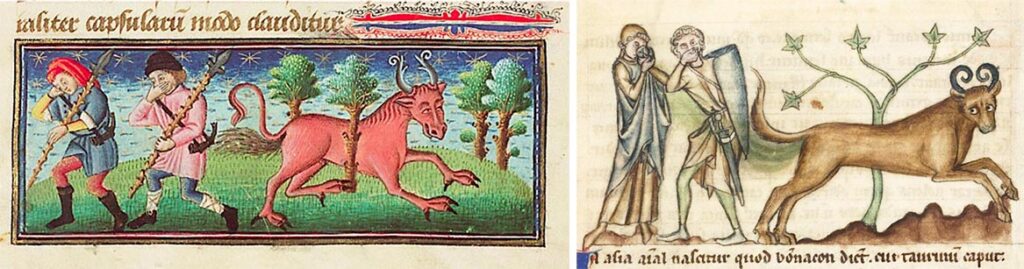
If you’ve never encountered a Bonnacon in Medieval art before, I think the pictures speak for themselves.
Naturally, I showed them to my kids.
They absolutely lost it.
There was laughter. There were questions. There was an immediate need to know more.
And I started thinking… if ONE strange Medieval beast could get this kind of reaction, what else was hiding in these manuscripts?
That was the beginning of a very entertaining research rabbit hole.
Medieval Art Gets Weird
Once I started looking, there was no shortage of strange creatures.
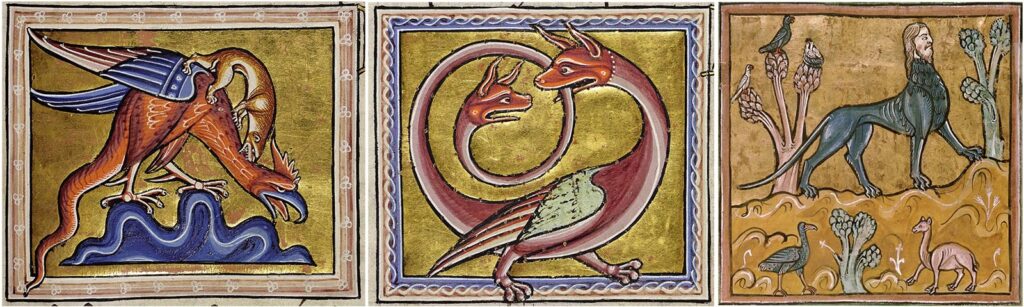
There were people with faces on their chests. People with one enormous foot. Dog-headed humans. People with ears so large they could supposedly use them like blankets. Two-headed serpents. Creatures disguised as islands.
Medieval art history had suddenly become very weird.
But the more I researched, the more interesting the story became.
I originally approached these as strange Medieval creatures, but many of their stories were actually much older than the Middle Ages. Some could be traced back through Roman and ancient Greek writings. The stories had been copied, repeated, changed and passed along for centuries before Medieval artists ever illustrated them.
That led me to the part I found most fascinating.
These artists were being asked to draw creatures they had never seen.
Sometimes all they had was a written description, an older image or a story that had already travelled through generations of retelling.
No wonder the results could get interesting.
How Do You Draw Something You’ve Never Seen?
That question eventually became the heart of the entire lesson:
How would YOU draw something you had never seen?
I chose 13 wonderfully strange beasts and legendary peoples and built the lesson around their stories and the artwork they inspired. I wanted the kids to see the authentic historical images, but I also wanted them to really LOOK at them.
Why does this artist’s creature look different from that artist’s version?
What details did the artist include?
What happens when several people try to illustrate the same strange description?
And, of course, there were plenty of crazy facts along the way.
Then it was time to see whether kids would actually find all of this as fascinating as I did.
Turns Out Kids Really Like Weird Medieval Art
I took the finished PDF lesson to my art class and showed it as a slideshow on a big screen.
I wasn’t quite prepared for the reactions.
Every new creature was like a reveal.
Jaws dropped. Kids laughed. They called things out. They wanted to know what the creatures did and why anyone thought they existed. I would explain one, move to the next slide, and immediately have their full attention again.
It is not every day that a group of kids gets this excited about learning Medieval art history. 😂
I had wondered beforehand whether this particular subject might appeal more to the boys.
Nope.
Apparently weird is universal.
The girls were every bit as invested. Some eventually created gentler creatures, including beautiful underwater beasts and imaginative animal combinations, while others went in completely different directions.
The room was full of very, very strange animals.
“Wait, I Get to Create ANY Creature I Want?”
After we had looked at all 13 creatures, I finally told the kids what their project was going to be.
They were going to invent a beast that nobody had ever seen before.
One little girl looked at me and said:
“Wait, I get to create any creature I want?”
YES.
She immediately dove into her artwork.
And that reaction was exactly what I had hoped for when I designed the project.
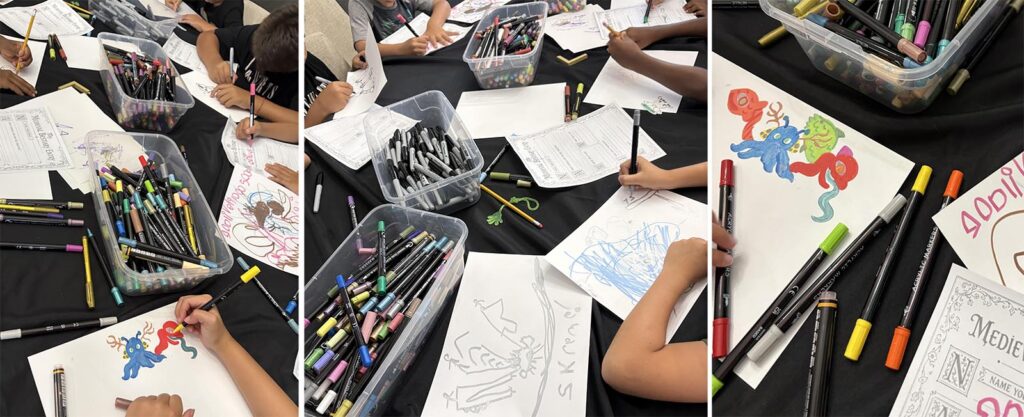
I deliberately did not show the class a finished example of a beast I had invented. Kids are very good at deciding that the teacher’s example must secretly be the “right” answer, and I didn’t want a room full of variations of my creature.
Instead, they had all those wonderfully strange Medieval images in their heads, a few prompts to get them started and complete freedom to decide what happened next.
The results were completely different from one another.
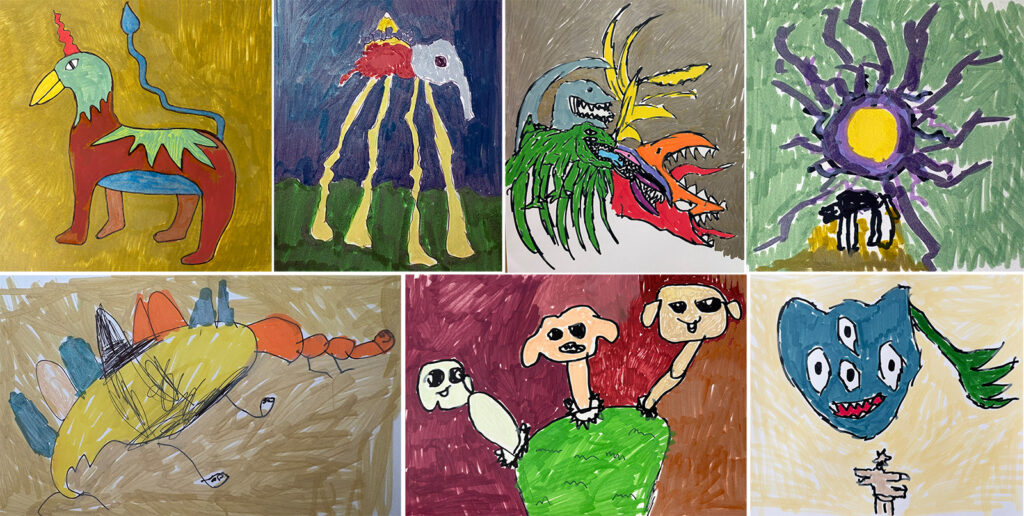
Some combined familiar animals. Some invented impossible bodies. Some had ridiculous powers. Some were fierce. Some were funny. Some were surprisingly beautiful.
Exactly what I wanted.
The Optional Worksheet Nobody Wanted to Skip
I also created a Medieval Bestiary Entry page to go with the project.
The kids could name their creature, explain what animals they combined, decide where it lived, describe what it did, give it a meaning and invent a Crazy Fact.
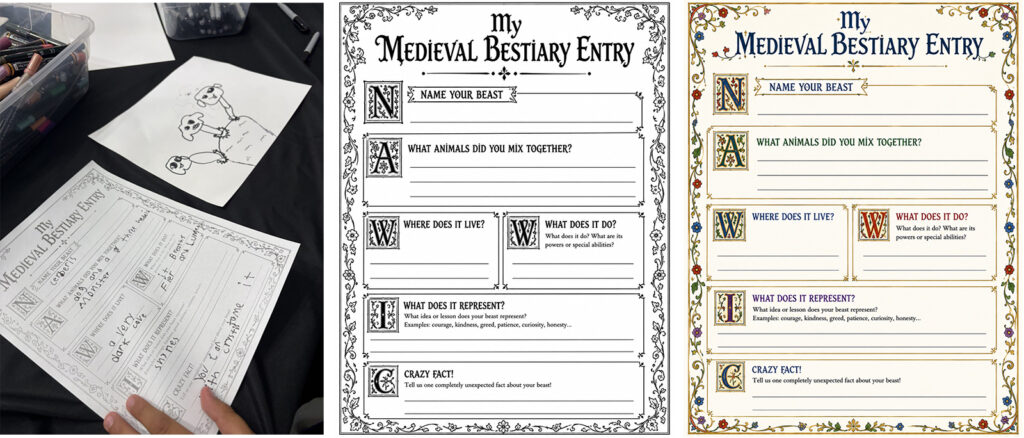
I made this part optional.
This is an art lesson, and I didn’t want the project suddenly turning into a writing assignment. Teachers can absolutely require the Bestiary Entry if they want to add more writing, but for my class I told the kids they didn’t have to complete it.
And then almost everybody wanted to.
That surprised me.
But once I watched them, it made perfect sense. They weren’t filling out a worksheet because I told them they had to write about their artwork. They were naming a creature they had just invented and deciding what ridiculous things it could do.
They wanted to tell me about their beasts.
The writing had simply become another part of the imaginary world they were creating.
From One Strange Picture to an Entire Art Lesson
This lesson started because one bizarre creature kept catching my attention while I was researching something completely different.
I showed the Bonnacon to the kids because I thought they would find the Medieval pictures funny.
They did.
Very funny.
But what began with laughter turned into one of those art classes where everything seemed to click. The kids were looking closely at historical artwork. They were asking questions. They were learning about Medieval manuscripts and how stories and images travelled through history. And when it was finally their turn to create, they couldn’t wait to begin.
That is probably my favorite kind of art history lesson.
The history gives them something fascinating to discover.
The artwork gives them something strange and wonderful to look at.
And then all of that disappears into their imaginations and comes back out as something completely their own.
All because of the Bonnacon.
Of course.
See What the Bonnacon Started
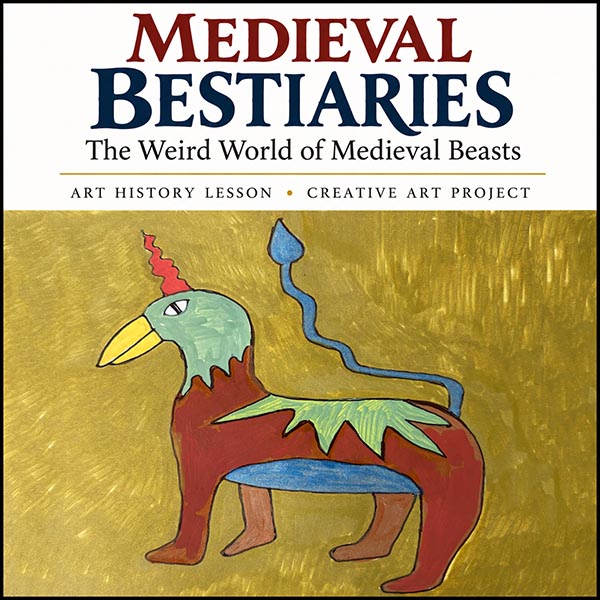
Image Credits
The historical images featured in this article are Public Domain works. The Bonnacon images appear in the collage near the beginning of the article, while the Basilisk, Amphisbaena, and Manticore appear together in the Medieval creatures collage. Classroom photographs, photographs of student artwork, and Zappy Arts resource images are my own.
Bonnacon Collage
Bonnacon, c. 1450 — Medieval manuscript illustration, The Hague, MMW, 10 B 25, fol. 8r. Public Domain. Source: Wikimedia Commons / The Public Domain Review.
Bonnacon, c. 1285 — De Natura animalium, Bibliothèque Municipale de Douai, MS 711, fol. 8r. Public Domain. Also featured in the blog cover image. Source: Wikimedia Commons / The Public Domain Review.
Medieval Creatures Collage
Basilisk — Aberdeen Bestiary, University of Aberdeen Library. Public Domain. Source: Wikimedia Commons / University of Aberdeen.
Amphisbaena — Aberdeen Bestiary, fol. 68v, University of Aberdeen Library. Public Domain. Source: Wikimedia Commons / University of Aberdeen.
Manticore — British Library, Royal MS 12 F XIII, fol. 24v. Public Domain. Source: Wikimedia Commons / British Library.