How a Few Medieval Worksheets Turned Into 40 Pages
This was supposed to be simple.
I was going to make a few fun Medieval art worksheets.
Knights. Castles. Maybe a shield. Very reasonable.
The worksheets were designed. Done!
Except then I sat there looking at them and thought…
How in the world is a kid supposed to design any of this if they have no idea what it actually looked like?
Well. Obviously they needed examples.
And that is approximately where things got out of hand. 😂
Several days later, I was deep inside European museum and library archives searching for everything from Medieval clothing and illuminated manuscripts to 12th-century Spanish corbels, trying to find authentic historical examples that were accurate, interesting, AND actually useful as inspiration for kids.
My quick little worksheet idea was no longer quick. Or little.
It Started With “They Need to See the Real Thing”
Once I decided the worksheets needed visual references, I couldn’t bring myself to just throw in vaguely Medieval-looking illustrations and call it a day.
If students were going to design a Medieval knight, I wanted them to see Medieval knights. If they were creating an illuminated manuscript, I wanted them looking at actual manuscripts. Castles, stained glass, clothing, heraldry, bestiary creatures – I wanted the creative projects connected to real historical art and objects.
This sounded easy.
It was not easy.
Take Medieval clothing.
I thought it would be wonderful to show students surviving Medieval garments. Very historically accurate! Very educational!
Then I found them.
Brown.
Brown.
Slightly different brown.
😂
They are fascinating historical objects. They are also not particularly helpful when you’re trying to get a child excited about designing elaborate Medieval clothing.
So I went back to Medieval manuscripts – and there they were. Gorgeous colors, dramatic sleeves, elaborate gowns, fantastic hats.
THANK YOU, Très Riches Heures. You saved Medieval fashion day.
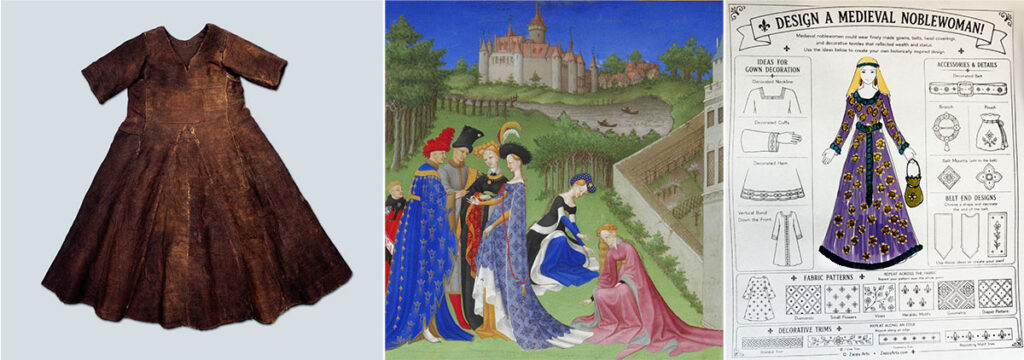
Image credits: Herjolfsnes garment No. 39 — National Museum of Denmark, photo by Peter Danstrøm, CC BY-SA. Les Très Riches Heures du duc de Berry, “April” — Limbourg brothers, c. 1412–1416, Public Domain. Zappy Arts worksheet © Zappy Arts.
Then Came the Great Gargoyle Hunt
I already knew exactly what I needed here. A true gargoyle isn’t simply a fantastic stone creature – it has an architectural job to do, carrying rainwater away from the building.
The problem was finding good authentic Medieval examples that worked for the project.
And that’s when the archive-hopping began.
Some of the wonderfully creepy creatures people immediately associate with Gothic cathedrals turned out not to be Medieval at all. The famous chimeras of Notre-Dame, for example, are 19th-century Gothic Revival additions.
Beautiful? Absolutely.
Medieval? Nope.
Back to the archives. 😂
Eventually I tracked down genuine Medieval examples, including gargoyles at Évora Cathedral and wonderfully bizarre 12th-century corbels at San Pedro de Cervatos.
At some point I realized I had spent a remarkable portion of my day inspecting stone monsters on European churches.
This was supposed to be a worksheet.
Then I Opened a Medieval Bestiary
This was a mistake.
A wonderful mistake.
Medieval bestiaries are absolutely bonkers.
There are dragons and griffins and basilisks. Real creatures mingle happily with imaginary ones. Animals carry symbolic meanings. And Medieval artists sometimes had the entertaining challenge of illustrating animals they may never have actually seen.
And then there is the bonnacon.
The bonnacon looks somewhat like a bull and, according to Medieval legend, defended itself from attackers by spraying burning dung behind itself.
I would just like everyone to appreciate that I was researching this for work.
😂
Suddenly the bestiary worksheet became one of my favorite projects in the entire collection.
And apparently I wasn’t alone.
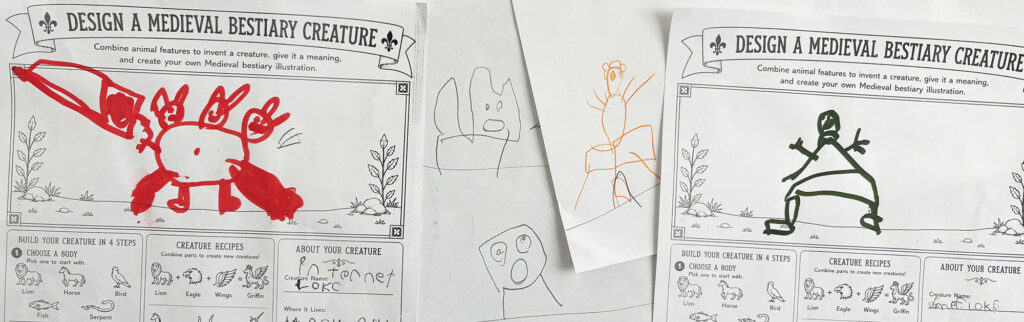
While I was testing the projects, I asked one of my little testers to make one Medieval beast.
One.
This instruction was ignored.
Beasts began multiplying.
Before long there were strange creatures everywhere, which was actually the best possible review of the project. Nobody was asking for more. The project had simply sparked an idea that was too much fun to stop.
Meanwhile, There Was an Actual Art Class Involved
I also taught an earlier version of these projects in one of my art classes.
And this is where you discover that the worksheet that looked absolutely perfect while you were designing it…
is not absolutely perfect. 😂
Watching a whole group of students work with something tells you things immediately. Maybe an area needs more drawing space. Maybe a figure should be larger. Maybe the examples give too much direction. Maybe something that makes perfect sense when you’ve been staring at it for six hours doesn’t make quite as much sense to someone seeing it for the first time.
So after the class, I went back to the templates.
And started changing things.
And changing things.
And changing things.
The classroom photos here show earlier development versions of the projects, so some of the templates pictured are different from the finished resource available today.
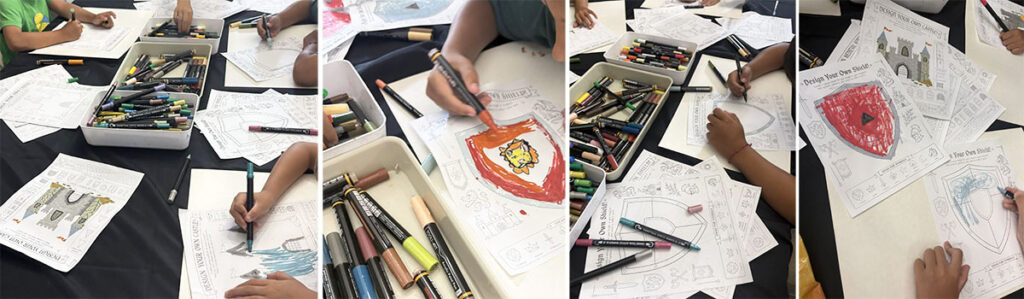
Early project testing – some templates shown here were later redesigned.
“I’ll Just Fix This One Little Thing”
Famous last words.
Some templates needed tiny adjustments.
Others… did not survive. 😂
I changed proportions. Enlarged drawing areas. Reworked visual prompts. Simplified layouts. Added ideas. Removed ideas. Printed things. Tested them. Changed them again.
The tricky part was finding the balance I wanted: enough visual guidance that a student isn’t sitting there thinking I have absolutely no idea how to start this, but not so much guidance that 30 students end up making 30 versions of exactly the same artwork.
Print.
Test.
Change.
Print again.
Stare at it.
Change something else.
At some point I stopped counting.
But honestly, this is one of my favorite parts of creating Zappy Arts resources. The goal isn’t to make a worksheet that looks impressive on my computer. It needs to work when a real student sits down with a pencil and actually tries to use it.
So Much for My Few Quick Medieval Worksheets
Eventually I looked at what I’d made.
There were knights.
And horses.
And noblewomen and noblemen.
Heraldry.
Illuminated manuscripts.
Bestiary creatures.
Castles.
Stained glass.
Gargoyles.
Grotesques.
A Gothic cathedral.
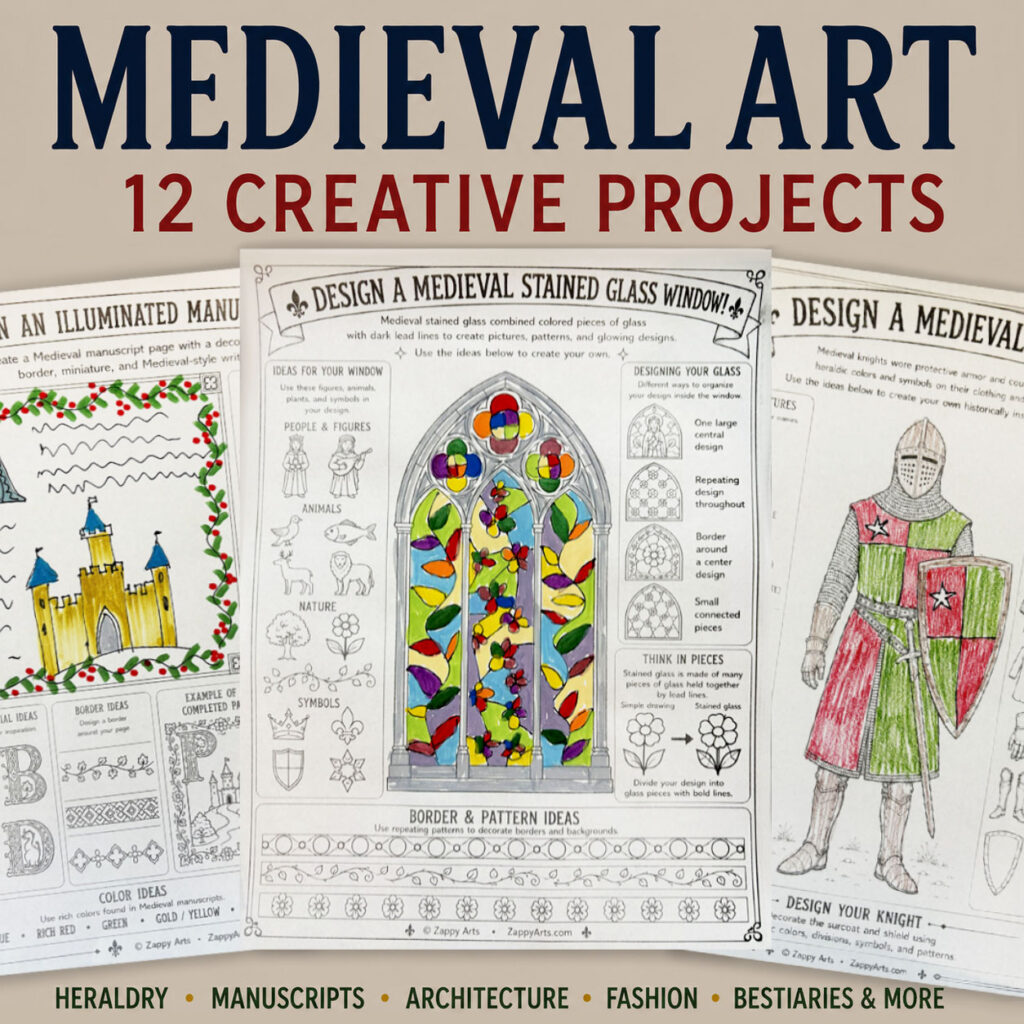
Somehow my few little Medieval worksheets had become a 40-page collection with 12 projects.
Oops. 😂
But that’s also why I love making these resources. I can start with a simple idea, fall down several historical rabbit holes, teach it, test it, discover what doesn’t work, change my mind approximately 400 times, and eventually end up somewhere much more interesting than where I started.
And occasionally I learn about a bull that shoots flaming poop.
Art history is magnificent.
See What All That Work Turned Into