But Did Vikings Actually Do That?
There is one question that follows me around whenever I’m creating an art history lesson:
But did they actually do that?
It’s an annoying little question.
Because sometimes I have a perfectly good idea for an art project. It’s fun. It looks great. Kids will love it.
And then my art history brain shows up.
Yeah… but is it true?
There goes my afternoon.
The Viking lesson gave me LOTS of these moments.
How Much Viking Art Does an Eight-Year-Old Need to Know?
Viking art is wonderfully weird.
Twisting animals. Interlacing bodies. Ribbons. Tendrils. Creatures tangled around other creatures.
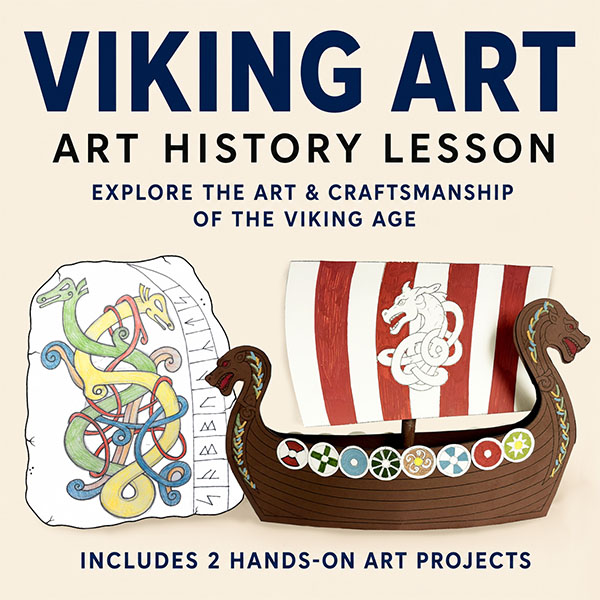
And then there are the gripping beasts.
Yes. That’s really what they’re called.
Obviously they were going into the lesson.
These little creatures appear in Viking art grabbing borders, ribbons, other animals and occasionally looking like they’ve gotten themselves into a situation they deeply regret.
I love them.
Now, could I give a group of kids a detailed lecture on the development of Viking animal ornament?
Sure.
Would they still be speaking to me afterward?
Possibly not.
So instead, we turn it into a game of sorts.
Find the head.
Follow the body.
Where did THAT leg go?
Which line goes over? Which one goes under?
Wait… is that even the same animal?
Suddenly we’re looking at Viking art like detectives instead of memorizing a bunch of names and dates.
Much better.
The Very Convenient Viking Alphabet That I Refused to Make
Then came the runestone project.
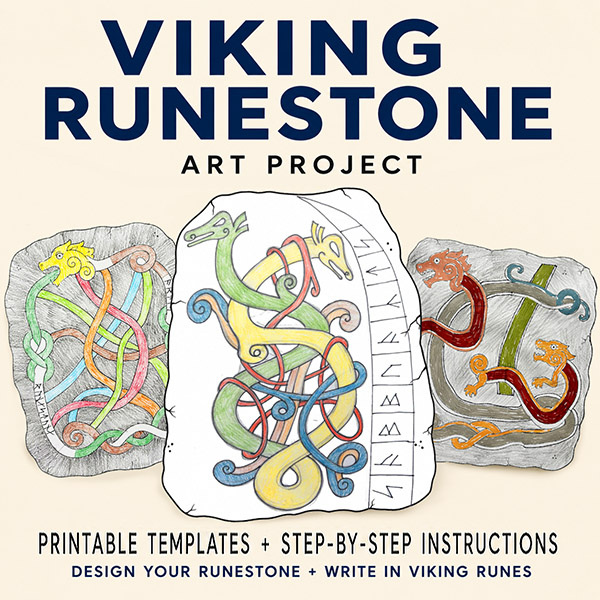
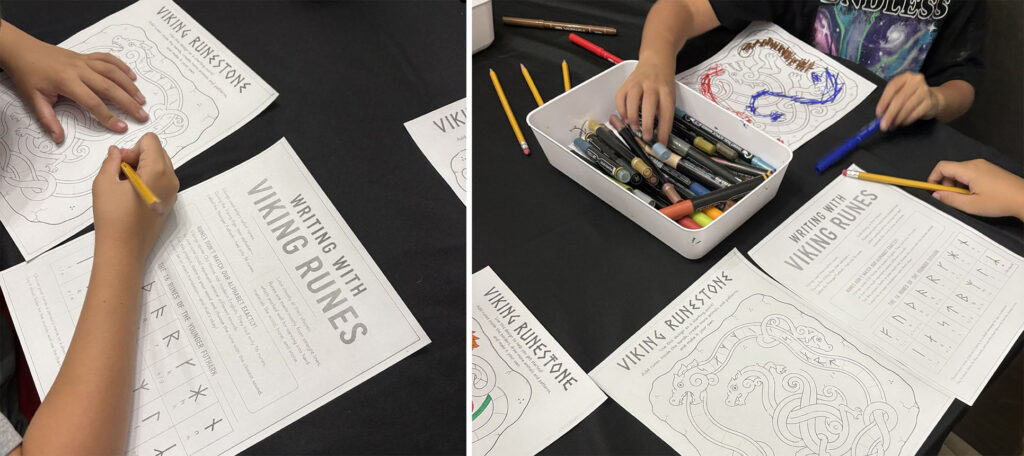
The plan was for kids to design their own Viking-inspired runestone and write their name, a word, or a little message in runes.
Easy.
All I needed was one of those handy A-to-Z Viking alphabet charts.
Except… no.
During the Viking Age, Younger Futhark had only 16 runes.
Sixteen runes and 26 English letters do not make for a nice convenient worksheet.
I could have created a simple chart where:
A = Viking-looking symbol
B = different Viking-looking symbol
C = another Viking-looking symbol
Everybody goes home happy.
Except me. 😂
Because that’s not really how Viking writing worked.
So the kids have to do a tiny bit more thinking. Instead of simply swapping letters for symbols, they listen to the sounds in the word they’re trying to write and choose the closest Younger Futhark runes.
Is it slightly more complicated?
Yep.
Is it also much cooler?
Definitely.
Now they’re not just decorating their artwork with mysterious Viking-looking symbols. They’re getting a little taste of how an actual Viking Age writing system worked.
Art history brain: satisfied.
Please Add Color to Your Ancient Gray Rock
Runestones gave me another perfect example.
Today we see them as old weathered stones, so naturally that’s how most of us picture them.
Gray stone. Carved lines. Very ancient. Very serious.
But many Viking runestones were originally painted.
YES.
Bring me the colored pencils.
This is one of those historical details that makes my job ridiculously easy because the accurate version is actually MORE fun for an art project.
No convincing necessary.
“Kids, Vikings painted their runestones.”
Done.
They’ve already reached for every color on the table.
And Then I Asked About the Sails
This one was my own fault.
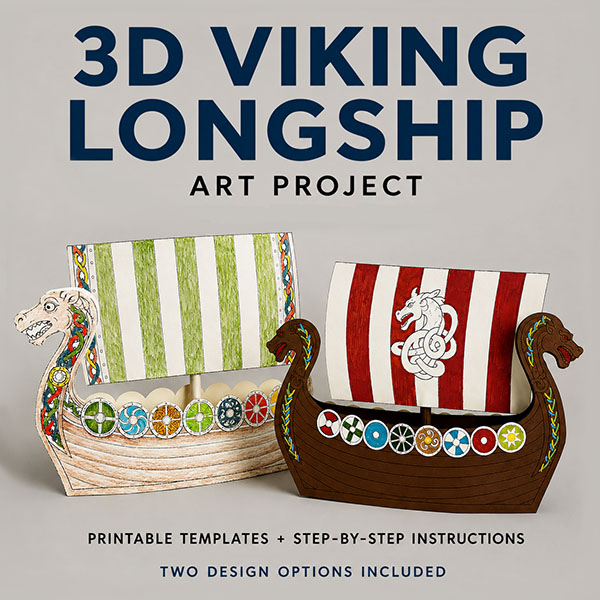
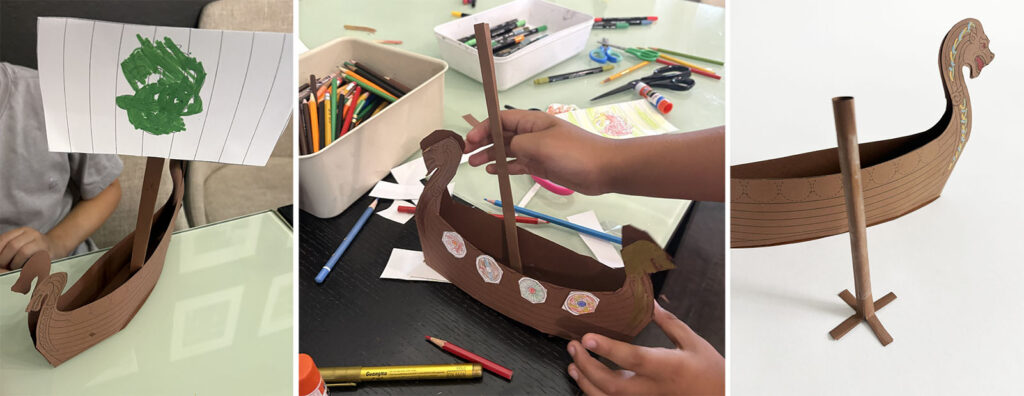
I had designed different sails for the 3D Viking longship project.
They looked good.
They looked Viking-ish.
Everyone could have been perfectly happy.
But there was that question again.
Did Vikings actually do that?
Sigh.
Off I went to check.
And Viking sails are one of those wonderful historical situations where the answer is basically:
Well… sort of… maybe… we have evidence… but not enough to know exactly.
We know Viking ships used square sails. There are archaeological clues, historical images, textile evidence, written sources and experimental reconstructions.
What we DON’T have is a convenient pile of perfectly preserved Viking sails showing us exactly what colors and patterns everyone used.
Very inconsiderate of the Vikings.
So I wasn’t comfortable telling kids:
THIS is what Viking sails looked like.
Instead, the project uses historically inspired sail designs, and I explain that we don’t know exactly what Viking sails looked like.
And I actually like that.
Kids should know that history has question marks.
We don’t dig up the past and find everything neatly labeled with an instruction manual.
Sometimes historians know.
Sometimes they have a really good idea.
And sometimes…
we’re not completely sure.
That’s allowed.
Great. It’s Historically Responsible. But Will It Stand Up?
Now we had another problem.
Because a historically responsible Viking ship that falls over is still a pretty lousy art project.
So I brought the longships to my art class to test them.
The ships looked great.
The shields worked.
The sails worked.
The mast said:
Absolutely not.
It kept flopping over.
And this turned out to be one of the most fun parts of the whole class because suddenly everyone wanted to solve it.
We had kids folding paper.
Reinforcing things.
Attaching things in different ways.
Trying little inventions.
Everybody had an idea.
My Viking art class had somehow become a Viking engineering lab.
Eventually, after all of our experimenting, we found the winner.
Take the paper mast strip.
Roll it tightly around a pencil.
Pull out the pencil.
Tape the little paper tube.
Done.
Strong little Viking mast.
All that engineering and brainstorming…
Pencil.
😂
This Is Exactly Why I Test These Things With Kids
I can sit at my desk and make a project work perfectly.
That’s lovely.
It proves almost nothing.
Hand it to a group of kids.
Now we’ll find out.
They will discover the weak point in approximately four seconds.
They’ll also come up with solutions I didn’t think of.
They’ll interpret my beautifully written instructions in ways I never imagined possible.
And they’ll take the artwork in completely different directions.
That’s my favorite part.
I can show them Viking animals and interlacing and runestones and historical examples, but once they start making their own…
All bets are off.
The creatures get weirder.
The colors get brighter.
The patterns go somewhere completely unexpected.
Occasionally a Viking animal ends up with a number of legs not currently recognized by science.
Fine by me.
The gripping beasts weren’t exactly concerned with anatomical accuracy either.
So How Historically Accurate Does a Kids’ Art Project Need to Be?
For me, the answer is pretty simple:
Don’t make stuff up just because it’s easier. But don’t suck all the fun out of it either.
That’s basically it.
I don’t need an eight-year-old to become an expert in Younger Futhark before picking up a pencil.
I don’t need kids memorizing all six major Viking art styles.
And nobody will be receiving a quiz on archaeological sail evidence at the end of art class.
But if we’re going to call something an art history project, I want the history underneath it to be real.
And the funny thing is, the real stuff is usually better anyway.
Runestones were painted?
More color!
Viking artists made bizarre tangled creatures called gripping beasts?
We’re absolutely drawing those.
Younger Futhark only has 16 runes?
Well, now we have a puzzle to solve.
We don’t know exactly what Viking sails looked like?
Great. Let’s talk about why – and then design one.
The history isn’t getting in the way of the art.
It’s giving us better ideas.
Somewhere Between a Museum and a Glue Stick
I think that’s probably where Zappy Arts lives.
Somewhere between a museum and a glue stick.
I want kids to see real artwork and artifacts. I want them to learn something true about the people who made them. I want them to notice details they might otherwise walk straight past in a museum.
And then…
I want them to make something.
Cut it.
Color it.
Change it.
Make the animal completely ridiculous.
Build a Viking ship.
Write their name in runes.
And, apparently, engineer a mast with a pencil.
That’s the part of creating these lessons that you don’t see when everything is finally cleaned up, organized and turned into a nice PDF.
Behind that nice PDF there is research, artwork, testing, a classroom full of opinions, several failed ideas…
…and at least one Viking ship refusing to cooperate.
But the masts stand up now.
Victory. 😂
See What All That Work Turned Into