Behind the Surrealism Art Project
Sometimes a Surrealism art project begins with an artist, an artwork, or a historical period I can’t wait to explore.
This one began with a logistical problem.
I needed an art project that could work with a very large group of children in a park pavilion – with no projector, not enough tables, and students drawing on blankets wherever they could find a spot.
I needed something simple to organize, easy to carry, and interesting enough to keep a lot of kids engaged.
Somewhere in all that planning, four little mystery bags appeared in my head.
Four bags. Four mystery cards. One very strange drawing.
That was the plan.
Four Cards. Now Figure It Out.
The idea was simple.
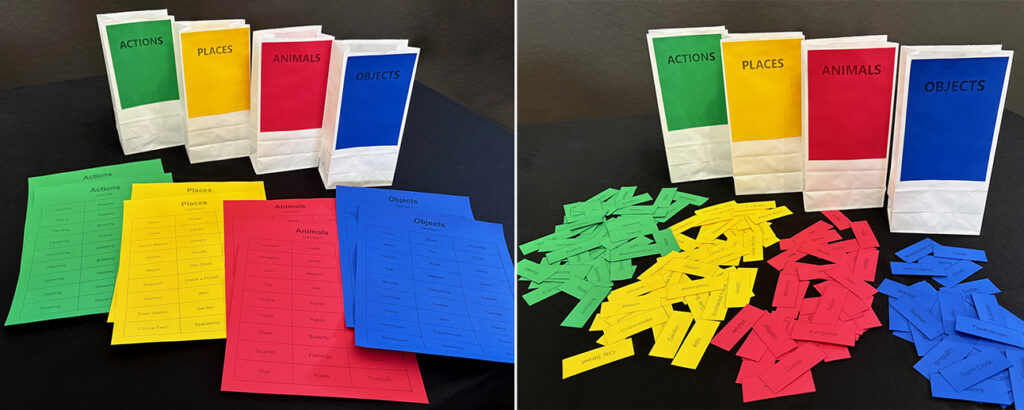
Each student would randomly choose four cards:
BLUE – Object
RED – Animal
GREEN – Action
YELLOW – Place
Then they had to somehow combine all four into one artwork.
Some combinations sounded completely ridiculous.
Which, of course, was exactly the point.
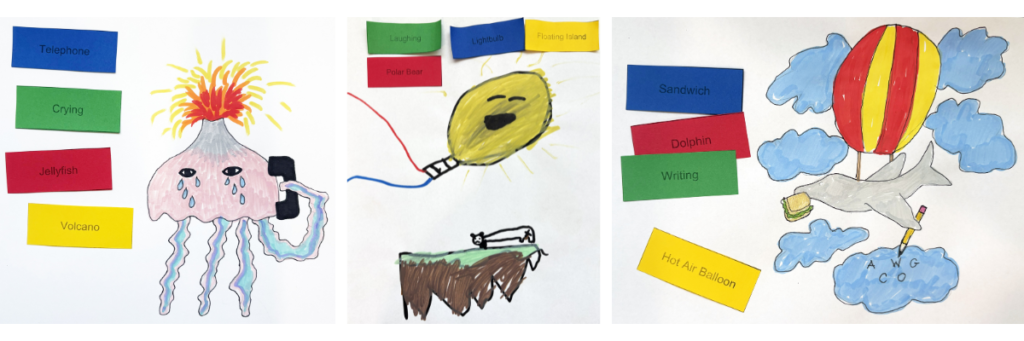
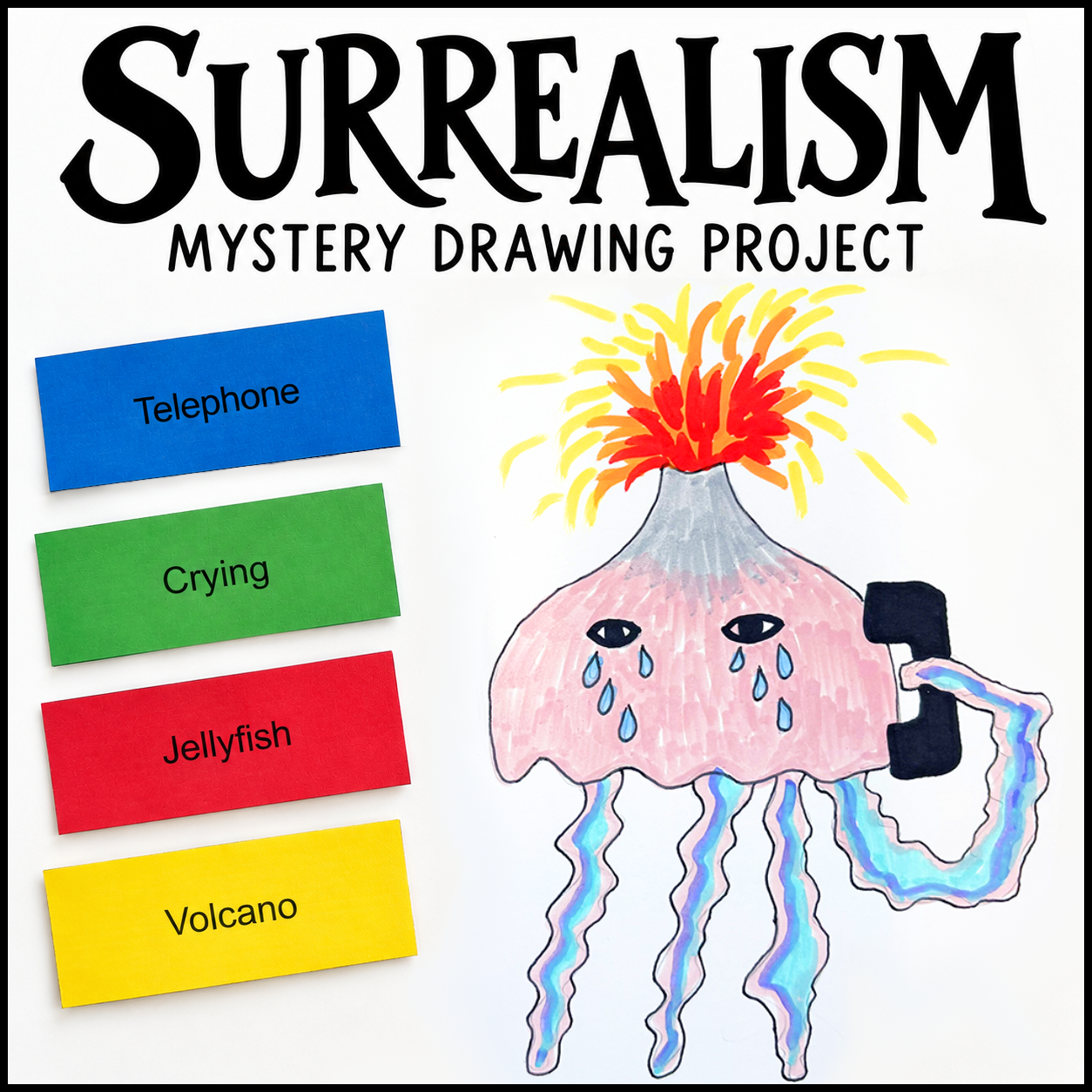
One student pulled Telephone + Jellyfish + Crying + Volcano and somehow turned that into a crying jellyfish with a volcano erupting from its head while it held a telephone.
The cards gave the kids the ingredients, but they had to figure out the recipe.
With 54 cards in each category, there are 8,503,056 possible combinations.
So we should be good for a while.
Surely I Can Just Buy Four Colored Bags
I had a beautiful little picture in my head.
Blue bag for Objects.
Red bag for Animals.
Green bag for Actions.
Yellow bag for Places.
Easy.
Then I started shopping.
Apparently nobody selling paper bags had been informed about my very specific Surrealism color scheme.
I found some colors but not others. Sets containing three colors I needed and several I didn’t. Different sizes. Separate packages. And suddenly four little paper bags were becoming considerably more expensive and complicated than four little paper bags had any right to be.
At some point during this search I remember thinking:
Geeesh, I don’t want to subject any teacher to this. This is ridiculous.
So I stopped looking for the perfect bags.
I bought inexpensive white ones and made labels instead.
And then I realized that was actually a much better idea.
You don’t need my bags at all.
Use white bags. Brown lunch bags. Boxes. Jars. Baskets. Cups. Classroom bins. Whatever is already sitting in your cabinet.
Stick the label on it.
Done.
Sometimes giving up is apparently part of the design process.
Then I Had Another Brilliant Idea
This one was considerably less brilliant.
I didn’t want the kids peeking at the cards and choosing the easiest or funniest prompt, so I decided the cards should be curled up to hide the words.
Makes sense, right?
Except…
The cards were going inside bags.
The kids were reaching into the bags without seeing them anyway.
This realization apparently did not stop me.
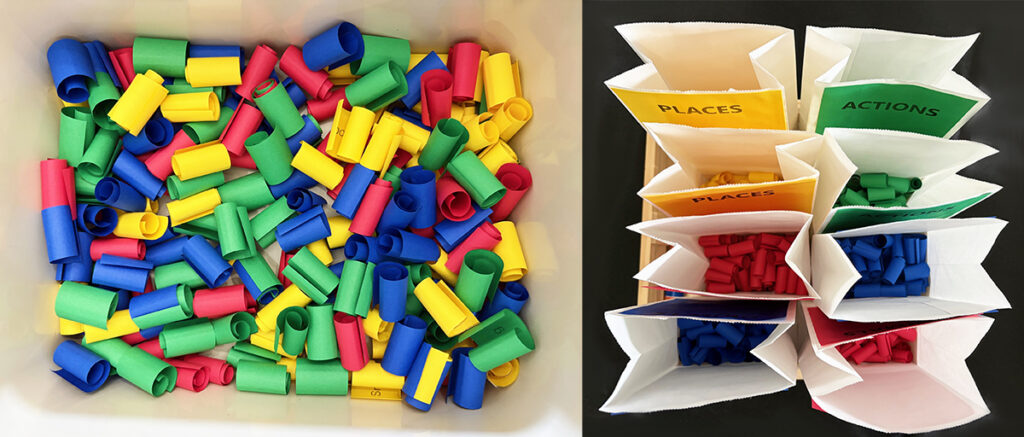
I had printed three complete sets for the large class.
That’s 648 cards.
And I curled every single one.
Individually.
Around a chopstick.
I wish I could tell you I curled the first 30, realized this was completely unnecessary, and stopped.
I did not.
There were 648 cards.
There was a chopstick.
There was eventually a blister.
Were they adorable?
Yes.
Did curling them prevent the kids from seeing the words?
Also yes.
Did the bags already accomplish exactly the same thing?
…yes.
Please admire them in the photograph. I suffered for those curls.
And if you’re preparing this project yourself, learn from me:
Cut the cards apart. Put them in the containers. Walk away.
An Elephant Walks Into an Art Lesson…
Of course, I didn’t want to hand the kids four random cards and simply tell them to make something weird.
This was still an art lesson.
So before anyone touched the mystery bags, I asked everyone to imagine an elephant.
Just a normal elephant.
Then I started ruining it.
Make its legs incredibly long and skinny.
Put something strange on its back.
Place it in a huge, empty landscape.
By this point, the elephant in everyone’s head was becoming completely ridiculous.
Then I showed them Salvador Dalí’s The Elephants.
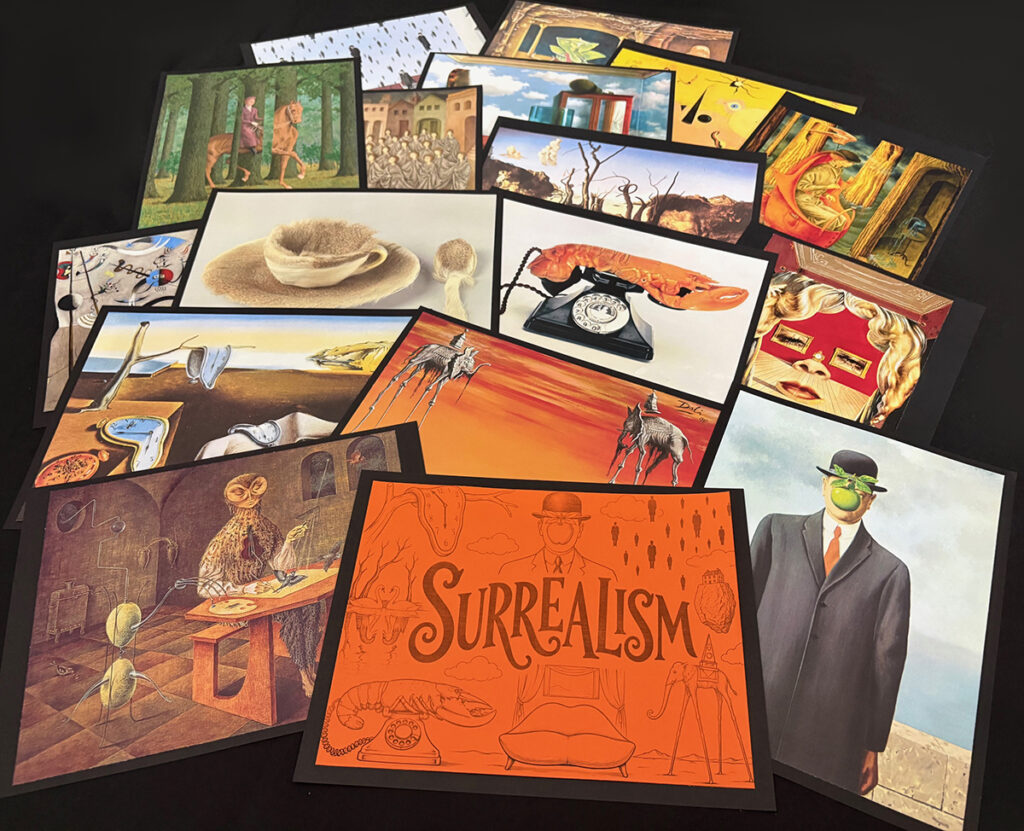
That was the moment Surrealism clicked.
We looked at more artworks by Salvador Dalí, René Magritte, Meret Oppenheim, Leonora Carrington, and Remedios Varo and started looking for the tricks.
What was normal?
What had the artist changed?
Something enormous?
Something where it didn’t belong?
Two unrelated things combined?
Something transformed into something else?
The kids didn’t need a long lecture about Surrealism. Once they started spotting those strange choices in real artworks, they understood exactly what they were about to do with their own four cards.
Did We Need a Surrealism Sign?
Technically?
No.
Did I make one anyway?
Obviously.
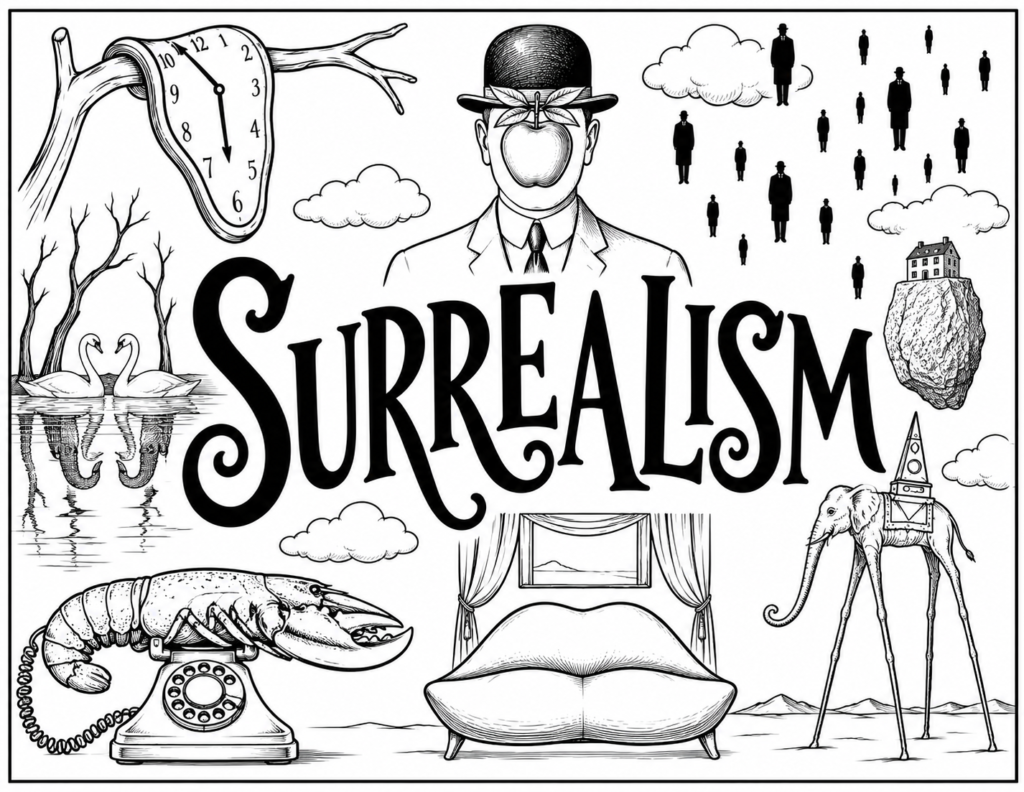
I wanted something simple to identify the artwork-viewing area, so I created a black-and-white SURREALISM display sign inspired by the strange visual ideas we were discussing.
I printed mine on bright orange paper and placed it with the artwork collection.
It served absolutely no essential logistical purpose.
But it looked great.
So naturally, it ended up in the finished resource too.
It can be printed on white or colored paper and used with an artwork-viewing area, the Mystery Card station, or a display of finished student artwork.
Sometimes things are allowed to exist simply because they’re fun.
Ten Kids? Easy.
Before unleashing this idea on a giant group, I tested it with 10 children.
One card set.
Four bags.
Perfect.
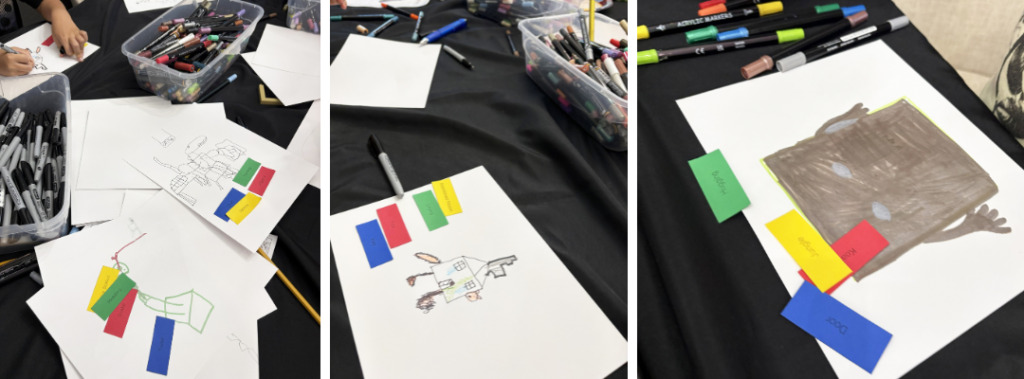
The kids pulled their four prompts, spread the cards beside their papers, and started drawing.
And this was when I knew the project worked.
Nobody needed to draw the same thing.
Nobody needed to copy my example.
Even when the combinations were completely absurd, the kids figured something out.
And their solutions were much more interesting than anything I could have planned for them.
And Then There Were 120.
Then came the real test.
120 children.
The largest art class I had ever taught.
I arrived armed with three complete card sets, eight Mystery Bags, piles of art supplies, printed Surrealist artworks, clipboards…
…and 648 unnecessarily curled cards.
The activity itself worked beautifully.
The card distribution?
That part taught me something.
Each of those 120 children needed four cards. Even with eight bags circulating, that is a LOT of little hands waiting to pull cards.
And suddenly the obvious solution hit me.
I didn’t need more cards.
I needed more bags.
For a huge group, the same cards can simply be divided among more containers so several children can choose at the same time.
That little discovery went straight into the finished lesson.
Small group? Four containers worked perfectly.
Huge group? Spread those cards out.
This is exactly why I like testing my projects with real kids before I consider them finished. There are things you simply don’t discover while sitting at a computer designing a PDF.
The Little Things I Fixed Along the Way
There were a few other things I discovered while actually preparing the project.
After printing page after page after page of colored cards, I repeatedly found myself staring at the printer thinking:
Wait. Is this one supposed to be yellow or blue?
And I designed the thing.
So I went back to the printable and added a clear instruction at the top of every card page telling you exactly which color paper to use – blue for Objects, red for Animals, green for Actions, and yellow for Places. I added the same color-coded instructions to the printable container labels too.
No remembering. No flipping back through the instructions. No standing beside the printer questioning your own color system.
Because apparently even the person who designed the color system can forget the color system.
I also added the printable container labels, tips for different group sizes, flexible material suggestions, and one more printable that wasn’t part of my original plan.
Let the Artist Explain
After looking at the finished artwork, I realized something.
Some of these pictures are wonderfully bizarre.
And without knowing the four mystery prompts, you might have absolutely no idea what is happening.
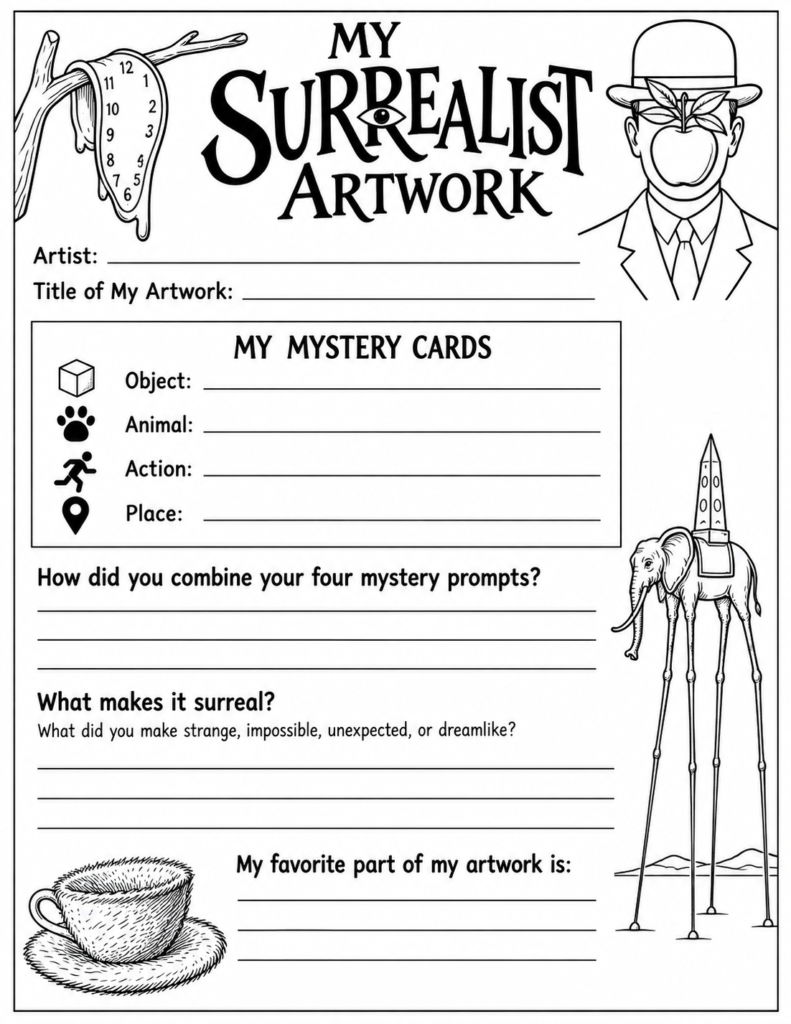
So I created a Surrealist Artwork Entry Form.
Students can record their four cards, explain how they combined them, and answer one particularly important question:
What makes it Surreal?
The form can also be displayed beside the finished artwork, which turns the whole thing into a little Surrealist gallery.
Now visitors don’t just see a jellyfish with a volcano erupting from its head while it cries into a telephone.
They get to find out why there’s a jellyfish with a volcano erupting from its head while it cries into a telephone.
Important distinction.
Four Colors. Four Prompts. One Very Strange Artwork.
What started as:
I need something a giant group of kids can do without tables…
somehow became 216 Mystery Cards, printable container labels, a Surrealism introduction, an artwork-viewing guide, an entry form, a display sign, two very different test groups, 120 children…
…and one completely unnecessary chopstick blister.
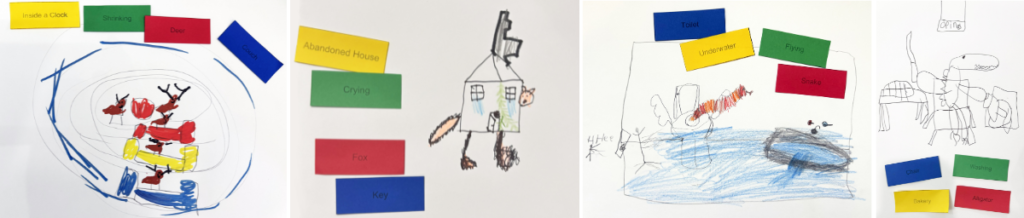
But watching the kids pull four completely unrelated words and turn them into things I never would have imagined myself?
Yep.
Worth it.
Four colors. Four prompts. One very strange artwork.
Ready to Try It?
Click the lesson cover below to explore the complete Surrealist Mystery Drawing Project.